ShareThis

Thursday, August 23, 2012

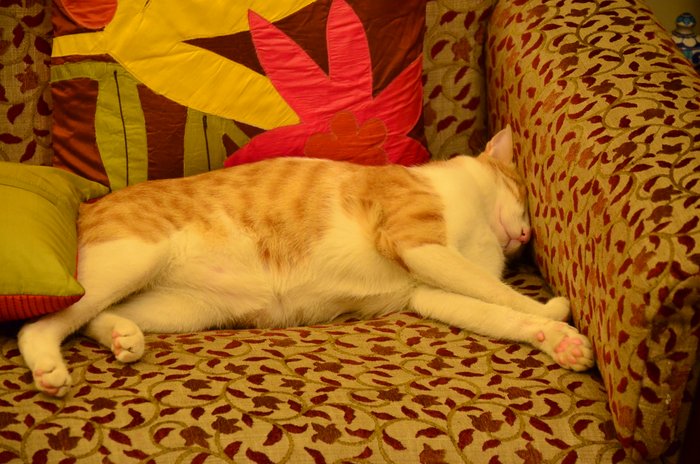
Cats are not Cute!

So you think cats are cute? Here's a little story of Ninja the Cat.

Sure he is cute, when you look at him this way


Or this way!....So adorable


But when you see him do this...
ruining a perfectly good chair in a few months


No that is not fur my chair is growing.

Now look at him from the eyes of a Ninja the cutie to Ninja the Destroyer!


Not so cute now is he? OMG look at that big stomach of his!!!!!!

So I say please, do not be deceived by cute furry bums like his.


Tuesday, August 14, 2012

Indian flag over the years


Indian flag over the years...interesting!


Aspartame is fine!?


What is Aspartame and why is the poor thing getting such bad press...

http://www.gustrength.com/eric-troy:the-aspartame-mythinformation-campaign


Can my Pharmaceuticalist family please confirm (or reject) this?


...As par tame...?!?


Monday, August 13, 2012

Awesomely funny Sony error


Love Sony's sense of humour, this is error message I got when surfing on the Sony site.
I least expected Sony to be this casual and funny. Way to go Sony! :)

Click to see bigger


Saturday, July 28, 2012

Gandhiji not on Twitter

Modern followers...


from DNA Mumbai Saturday 28th July Page 15

Friday, July 20, 2012

Thursday, July 19, 2012

Sunday, July 15, 2012

The 11 Ways That Consumers Are Hopeless at Math

 
 By Derek Thompson
This is your brain on shopping, and it's not very smart

You walk into a Starbucks and see two deals for a cup of coffee. The first deal offers 33% extra coffee. The second takes 33% off the regular price. What's the better deal?
"They're about equal!" you'd say, if you're like the students who participated in a new study published in the Journal of Marketing. And you'd be wrong. The deals appear to be equivalent, but in fact, a 33% discount is the same as a 50 percent increase in quantity. Math time: Let's say the standard coffee is $1 for 3 quarts ($0.33 per quart). The first deal gets you 4 quarts for $1 ($0.25 per quart) and the second gets you 3 quarts for 66 cents ($.22 per quart).
The upshot: Getting something extra "for free" feels better than getting the same for less. The applications of this simple fact are huge. Selling cereal? Don't talk up the discount. Talk how much bigger the box is! Selling a car? Skip the MPG conversion. Talk about all the extra miles.
There are two broad reasons why these kind of tricks work. First: Consumers don't know what the heck anything should cost, so we rely on parts of our brains that aren't strictly quantitative. Second: Although humans spend in numbered dollars, we make decisions based on clues and half-thinking that amount to innumeracy.
Here are 10 more ways consumers are bad at math, with an assist from historian and author William Poundstone.
(2) We're heavily influenced by the first number. You walk into a high-end store, let's say it's Hermès, and you see a $7,000 bag. "Haha, that's so stupid!" you tell your friend. "Seven grand for a bag!" Then you spot an awesome watch for $367. Compared to a Timex, that's wildly over-expensive. But compared to the $7,000 price tag you just put to memory, it's a steal. In this way, stores can massage or "anchor" your expectations for spending.
(3) We're terrified of extremes. We don't like feeling cheap, and we don't like feeling duped. Since we're not sure what things are worth, we shy away from prices that appear too high or too low. Stores can employ our bias for moderation against us. Here's a great story:
People were offered 2 kinds of beer: premium beer for $2.50 and bargain beer for $1.80. Around 80% chose the more expensive beer. Now a third beer was introduced, a super bargain beer for $1.60 in addition to the previous two. Now 80% bought the $1.80 beer and the rest $2.50 beer. Nobody bought the cheapest option.
Third time around, they removed the $1.60 beer and replaced with a super premium $3.40 beer. Most people chose the $2.50 beer, a small number $1.80 beer and around 10% opted for the most expensive $3.40 beer.
In short: We are all Goldilocks.
(4) We're in love with stories. In his book Priceless, William Poundstone explains what happened when Williams-Sonoma added a $429 breadmaker next to their $279 model: Sales of the cheaper model doubled even though practically nobody bought the $429 machine. Lesson: If you can't sell a product, try putting something nearly identical, but twice as expensive, next to it. It'll make the first product look like a gotta-have-it bargain. One explanation for why this tactic works is that people like stories or justifications. Since it's terribly hard to know the true value of things, we need narratives to explain our decisions to ourselves. Price differences give us a story and a motive: The $279 breadmaker was, like, 40 percent cheaper than the other model -- we got a great deal! Good story.
(5) We do what we're told. Behavioral economists love experimenting in schools, where they've found that shining a light on fruit and placing a salad bar in the way of the candy makes kids eat more fruit and salad. But adults are equally susceptible to these simple games. Savvy restaurants, for example, design their menus to draw our eyes to the most profitable items by things as simple as pictures and boxes. Good rule of thumb: If you see a course on the menu that's highlighted, boxed, illustrated, or paired with a really expensive item, it's probably a high-margin product that the restaurant hopes you'll see and consider.
(6) We let our emotions get the best of us. In a brilliant experiment from Poundstone's book, volunteers are offered a certain number of dollars out of $10. Offers seen as "unfair" ($1, let's say) activated the insula cortex, "which is otherwise triggered by pain and foul odors." When we feel like we're being ripped off, we literally feel disgusted -- even when it's a good deal. Poundstone equates this to the minibar experience. It's late, you're hungry, there's a Snickers right there, but you're so turned off by the price, that you starve yourself to avoid the feeling of being ripped off. The flip-side is that bargains literally make us feel good about ourselves. Even the most useless junk in the world is appealing if the price feels like a steal.
(7) We're easily made dumber by alcohol, time, decisions. When you're young and drunk at a bar, you're more likely to do stupid things with strangers. "Am I fully assessing this complex romantic situation?" is a difficult question to answer on seven glasses of wine, so we're more likely to ask ourselves a simpler question: "Is s/he hot?" When we're drunk, stressed, tired, and otherwise inattentive, we're more likely to ask and answer simple questions about buying things. Cheap candy bars and gum are situated near the check-out at grocery stores because that's where exhausted shoppers are most likely to indulge cravings without paying attention to price. Boozy lunches are good for deal-making because alcohol narrows the range of complicating factors we can hold in our heads at once. If you want somebody to take an under-examined risk, get him boozed, tired, or ego-depleted.
(8) We're pained by transaction costs... In a personal finance column here, Megan McArdle implored her readers to give up recurring payments like gym memberships and subscriptions to papers and services they don't use. "Don't buy stuff you don't consume" seems like obvious enough advice, but Megan had a great point. We're drawn to subscriptions and memberships and bundles partially because we seek to avoid transaction costs. We'd rather overpay a little than suffer the psychological pain of pulling out a wallet and watching our money go to each gym season/movie/etc.
(9) ... but we're weird about rebates and warranties. Now that I've just told you that consumers try to avoid additional payments, I should add that there are two additional payments we love: rebates and warranties. The first buys the illusion of wealth ("I'm being paid money to spend money!"). The second buys peace of mind ("Now I can own this thing forever without worrying about it!"). Both are basically tricks. "Instead of buying something and getting a rebate," Poundstone writes, "why not just pay a lower price in the first place?'
"[Warranties] make no rational sense," Harvard economist David Cutler told the Washington Post. "The implied probability that [a product] will break has to be substantially greater than the risk that you can't afford to fix it or replace it. If you're buying a $400 item, for the overwhelming number of consumers that level of spending is not a risk you need to insure under any circumstances."
(10) We're obsessed with the number 9. Up to 65 percent of all retail prices end in the number 9. Why? Everybody knows that $20 and $19.99 are the same thing. But the number 9 tells us something simple: This thing is discounted. This thing is cheap. This thing was priced by somebody who knows you like things discounted and cheap. In other words, 9 has transcended the status of charm price to become a cable of silent understanding between buyer and seller that a product is being priced competitively and fairly. Putting a 9 on a shell-fish platter at a high-end restaurant is ridiculous. Nobody spending $170 on lobster is looking for a discount. But the same person shopping for underwear is (research has shown, again and again) more likely to buy a product that ends in 9. Remember: Shopping is an attention game. Consumers aren't just hunting for products. They're hunting for clues that products are worth buying. In the number 9, the bargain-hunter/discount-gatherer corner of our brain spots a pluckable deal.
(11) We're compelled by a strong sense of fairness. I've already explained how our brains light up differently based on seeing a bargain vs. a rip-off. The shopper's brain is motivated by a sense of fairness. Again, it comes back to the idea that we don't know what things should cost, and so we use cues to tell us what we ought to pay for them. An experiment by the economist Dan Ariely tells the story beautifully. Ariely pretended he was giving a poetry recital. He told one group of students that the tickets cost money and another group that they would be paid to attend. Then he revealed to both groups that the recital was free. The first group was anxious to attend, believing they were getting something of value for free. The second group mostly declined, believing they were being forced to volunteer for the same event without compensation.
What's a poetry recital by a behavioral economist worth? The students had no idea. That's the point. I don't know, either. That's also the point. What's a button-up shirt "worth"? What's a cup of coffee "worth"? What's a life insurance policy "worth"? Who knows! Most of us don't. As a result, the shopping brain uses only what is knowable: visual clues, triggered emotions, comparisons, ratios, and a sense of bargain vs. rip-off. We're not stupid. Just susceptible.

Source
http://www.theatlantic.com/business/archive/2012/07/the-11-ways-that-consumers-are-hopeless-at-math/259479/


Saturday, June 30, 2012

Monday, June 25, 2012

Passenger from Singapore


This really happened at an airport:
 

Airport security guy:......... What's your name?

Passenger from Singapore: Batman  

Airport security guy:......... Your real name please?   

Passenger:...................... My name is Batman              

Airport security guy:......... Please don't try to be funny. What is your surname?

Passenger:...................... Superman


The airport security heavies are called in. They handcuff the passenger and take him away into custody.


Then they check his passport:


If you find this incredible, take a look at this link:


Thursday, June 14, 2012

National Geographic BEST pictures for the year.


Worth watching ......... 

These are the National Geographic BEST pictures for the year.


Check out this photo of zebra


Sunday, June 03, 2012

Mango Map of India

Mangoes from all over India. Very interesting!


Thursday, May 31, 2012

Hilarious BAWA's

Bawa Tips is the funniest capture of Bawaness online. Please share with friends, especially the Bawa kinds :)


Please see all the Bawa Tips on their Facebook page.


Also see the incredibly hilarious video made by them.


Thursday, April 26, 2012

8 Core Beliefs of Extraordinary Bosses

Here is a wonderful article on, what it truly means to run a business and manage people the right way! Where are you in this list?

This is perfectly in tune with Yoga, perfectly in tune with followers of light.

8 Core Beliefs of Extraordinary Bosses
http://www.inc.com/geoffrey-james/8-core-beliefs-of-extraordinary-bosses.html


Monday, April 23, 2012

Motion Induced Blindness


Motion Induced Blindness

 In a motor accident, wherein a speeding car hits a slower moving vehicle coming from the side, the speeding car drivers often swear that they just didn’t see the vehicle coming from the left or right.

 Well, they aren’t lying. They really don’t see the vehicle coming from the side, in spite of broad daylight. This phenomenon on the car drivers’ part is known as “Motion Induced Blindness”. It is unbelievable but it is true, and it is definitely frightening. Armed forces pilots are taught about motion induced blindness during training, because it happens faster at high speeds; and to some extent it is applicable to car drivers also, especially the fast ones. So, if you drive a car, please read this carefully.

 Once airborne, pilots are taught to alternate their gaze between scanning the horizon and scanning their instrument panel, and never to fix their gaze for more than a couple of seconds on any single object. They are taught to continually keep their heads on a swivel and their eyes always moving. Because, if you fix your gaze on one object long enough while you yourself are in motion, your peripheral vision goes blind. That’s why it is called motion induced blindness. For fighter pilots, this is the only way to survive in air; not only during aerial combat, but from peacetime hazards like mid-air collisions as well.

 Till about three decades ago, this “heads on swivel & eyes moving” technique was the only way to spot other aircraft in the skies around. Now-a-days they have on-board radars, but the old technique still
 holds good.

 Let me give you a small demonstration of motion induced blindness. This is the same demonstration that is used for trainee pilots in classrooms before they even go near an aircraft. Just click on the link below. You will see a revolving array of blue crosses on a black background. There is a flashing green dot in the centre and three fixed yellow dots around it. If you fix your gaze on the green dot for more than a few seconds, the yellow dots will disappear at random, either singly, or in pairs, or all three together. In reality, the yellow dots are always there. Just watch the yellow dots for some time to ensure that they don’t go anywhere!

 (You can alter the background colour or the rpm of the array by clicking the appropriate buttons. Notes given by the author below the rotating array are educative.)

 So, if you are driving at a high speed on a highway and if you fix your gaze on the road straight ahead, you will not see a car, a scooter, a buggy, a bicycle, a buffalo or even a human being approaching from the side. Now reverse the picture. If you are crossing a road on foot and you see a speeding car approaching. There’s a 90% chance that the driver isn’t seeing you, because his/her peripheral vision may be blind! And you may be in that blind zone!!


Friday, April 20, 2012

Awesome History of Art

Awesome History of Art

Click on image to see bigger


Monday, April 09, 2012

India - Culture of self interest

Think about it !...


Hobbesian (culture of self interest)


Corruption in India is a cultural aspect.

Thomas Hobbes
Indians seem to think nothing peculiar
about corruption . It is everywhere.

Indians tolerate corrupt individuals
rather than correct them.

No race can be congenitally corrupt.
But can a race be corrupted by its culture?

To know why Indians are corrupt ,
look at their patterns and practices.


First:

Religion is transactional in India.
Indians give God cash and anticipate
an out-of-turn reward.
Such a plea acknowledges that
favours are needed for the undeserving.

In the world outside the temple walls,
such a transaction is named- “bribe”.

A wealthy Indian gives not cash to temples,
but gold crowns and such baubles.

His gifts can not feed the poor.
His pay-off is for God.
He thinks it will be wasted
if it goes to a needy man.

In June 2009, The Hindu published
a report of Karnataka minister
G. Janardhan Reddy gifting
a crown of gold and diamonds worth
Rs 45 crore to Tirupati.

India’s temples collect so much that
they don't know what to do with it.
Billions are gathering dust in temple vaults.

When Europeans came to India they built schools.
When Indians go to Europe & USA, they build temples.

Indians believe that if God accepts money for his favours,
then nothing is wrong in doing the same thing.
This is why Indians are so easily corruptible.

Indian culture accommodates such transactions morally.


Second -

Indian moral ambiguity towards
corruption is visible in its history.

Indian history tells of the capture of cities
and kingdoms after guards
were paid off to open the gates, and
commanders paid off to surrender.

This is unique to India.

Indians' corrupt nature has meant limited
warfare on the subcontinent.
It is striking how little Indians have actually
fought compared to ancient Greece and modern Europe.

The Turks’ battles with Nadir Shah
were vicious and fought to the finish.

In India fighting wasn't needed,
bribing was enough to see off armies.

Any invader willing to spend cash
could brush aside India’s kings,
no matter how many tens of thousands of
soldiers were in their infantry.

Little resistance was given by the Indians
at the “Battle” of Plassey.
Clive paid off Mir Jaffar and all of
Bengal folded to an army of 3,000.

There was always a financial
exchange to taking Indian forts.
Golconda was captured in 1687
after the secret back door was left open.

Mughals vanquished Marathas
and Rajputs with nothing but bribes.

The Raja of Srinagar gave up
Dara Shikoh’s son Sulaiman to
Aurangzeb after receiving a bribe.

British bribed Dogras to defeat the Sikhs
by promising Dogra General Gulab Singh
and appointing him as the Maharaja of
Kashmir.

There are many cases where Indians
participated  on a large scale in
treason due to bribery.

Question is: Why Indians have a
transactional culture while
other 'civilized' nations don't?

 
Third -

Indians do not believe in the theory that they all can rise
if each of them behaves morally, because that is not
the message of their faith.

Their caste system separates them.
They don't believe that all men are equal.
This resulted in their division and
migration to other religions .

Many Hindus started their own
faith like Sikh, Jain, Buddha
and many converted to
Christianity and Islam.

The result is that Indians
don't trust one another .

There are no Indians in India, there are
Hindus, Christians, Muslims and what not.

Indians forget that 500 years ago
they mostly belonged to one faith.

This division evolved an unhealthy culture.
The inequality has resulted in a corrupt society,

In India every one is thus against everyone else,
except God and even he must be bribed.


CAN WE CHANGE OUR MIND SET?????

(The interesting read was sent via email)


For those wondering, Calvin and Hobbes creator Bill Watterson was highly influenced by Hobbes' philosophy and therefore the comic cat character Hobbes was given the name. You can see similar thought provoking ideas in his cartoons at the official site.


About Thomas Hobbes


http://en.wikipedia.org/wiki/Thomas_Hobbes